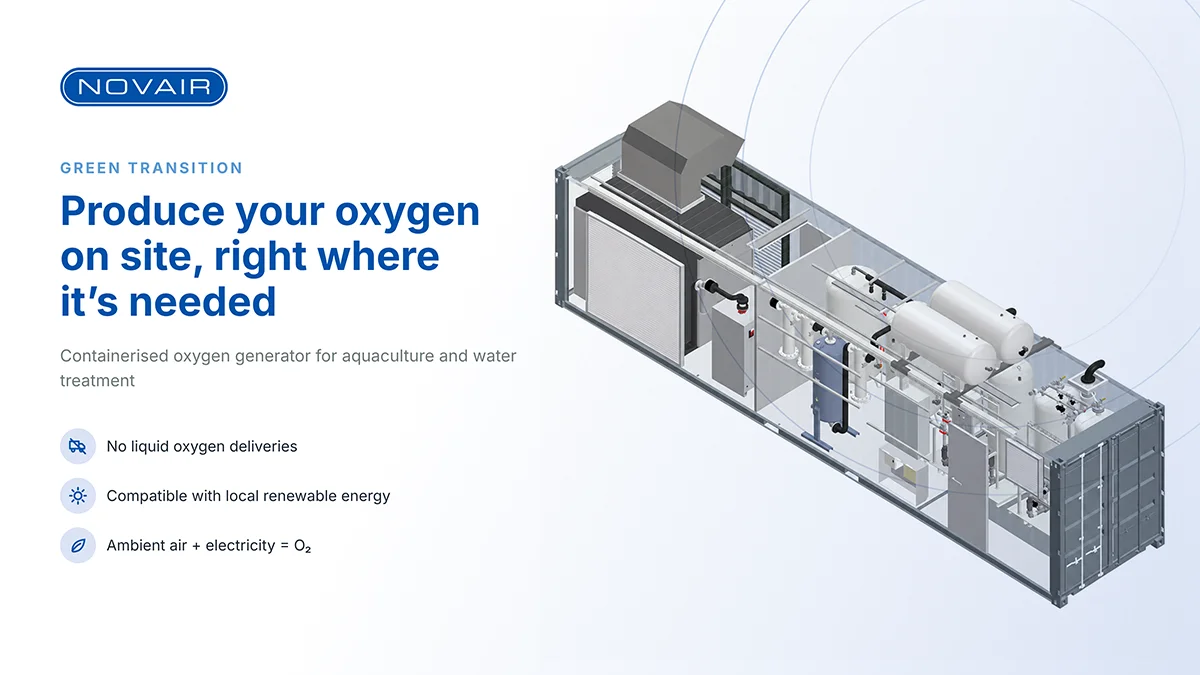
The green transition is pushing industrial companies to rethink how they produce and consume their resources: energy, water and also process gases. Oxygen is one of them. It is essential in aquaculture and water treatment. Yet it is still often delivered by truck, in liquid form or in cylinders, from centralised production plants.
The oxygen generator is a game changer. It produces oxygen where it is used, from ambient air and electricity. This local production reduces logistics flows and the dependencies that come with them. It can also run on renewable electricity and fits into wider systems combining energy, oxygen and water.
In this article, we look at how the on-site oxygen generator is becoming a real driver of the green transition, from fish farms to wastewater treatment plants.
On-site oxygen production: what are we talking about?
Ambient air as the only raw material
Air contains about 21% oxygen. An oxygen generator separates this oxygen from nitrogen, most often using PSA (Pressure Swing Adsorption) technology: a molecular sieve retains the nitrogen under pressure, and an oxygen-enriched gas is delivered directly to the process.
No raw material to buy, no cryogenic storage, no deliveries: just air, electricity and well-maintained equipment.
Less transport, fewer losses
For a site that uses oxygen regularly, conventional supply comes with constraints:
- regular truck deliveries, with their carbon footprint;
- a liquid oxygen tank on site and the boil-off losses that go with it;
- dependence on the supplier’s lead times and prices.
Producing on site eliminates these flows. Production follows the site’s actual demand, with no overstocking.
A more resilient installation
Recent supply chain tensions have shown it: relying on a delivered resource is a risk. The oxygen generator brings production closer to consumption. It does not provide complete autonomy, since it requires electricity and maintenance, but it significantly reduces exposure to supply disruptions.
Why the oxygen generator supports the green transition
Using renewable electricity produced on site
Solar, wind, biogas: more and more sites produce part of their own electricity. This raises a question: how can this energy be consumed at the very time it is produced?
When oxygen is part of the process, the generator is a good answer. It turns local, often renewable, electricity into a useful resource consumed on site. A transported resource becomes a resource produced locally with low-carbon energy.
Much more than a CO₂ issue
The green transition is not just about greenhouse gas emissions. Local oxygen production also helps to:
- reduce logistics flows and the related road traffic;
- use local renewable energy;
- match production to actual demand, without overconsumption;
- make installations more resilient;
- enable new water treatment processes, such as ozonation.
Oxygen generators and sustainable aquaculture
Dissolved oxygen, a vital parameter for fish farming
Dissolved oxygen directly determines fish growth, health and welfare. In intensive farming, oxygen demand rises with stocking density, feeding and biological activity. Without well-controlled oxygenation, good zootechnical performance is out of reach.
An essential building block of RAS
Recirculating Aquaculture Systems (RAS) continuously reuse filtered and treated water. As a result, they use far less water than flow-through farms, making them a key model for sustainable aquaculture.
In these systems, oxygenation is continuous. An oxygen generator integrated into the RAS supplies the required oxygen continuously and on demand, without relying on deliveries. This is a real safety gain for the fish stock.
Solar, oxygen and water: towards the integrated fish farm
Combining solar panels with an oxygen generator paves the way for a more self-sufficient fish farm: solar electricity powers oxygen production, which in turn supplies the fish. The same oxygen can also feed an ozone generator to treat the water in the loop.
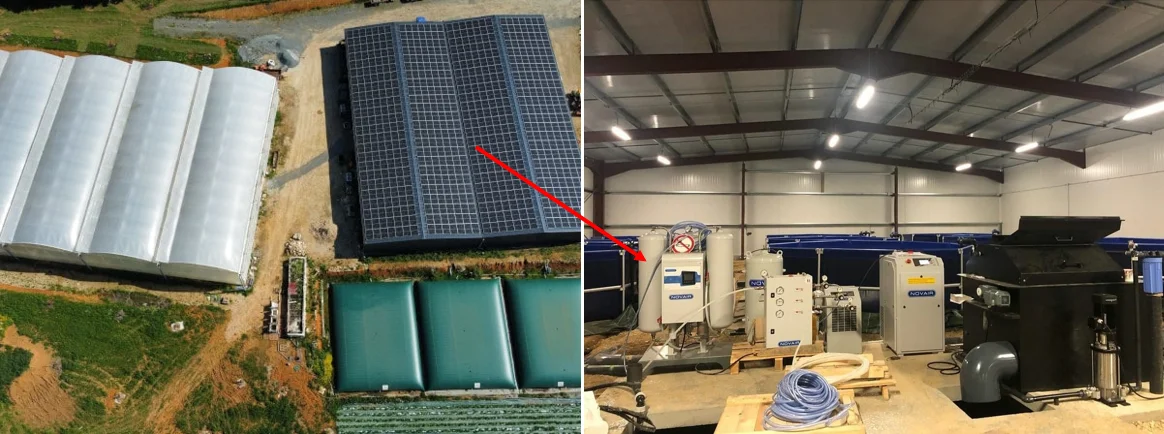
Novair O2 generator on the RAS loop in the solar-roofed building at La Truite Fleurie
Oxygen and ozone: a high-performance duo for water treatment
Producing ozone from oxygen
Ozone (O₃) is produced in an ozone generator from an oxygen-containing gas. Feeding the generator with concentrated oxygen rather than air yields ozone at a much higher and better-controlled concentration, with improved installation efficiency.
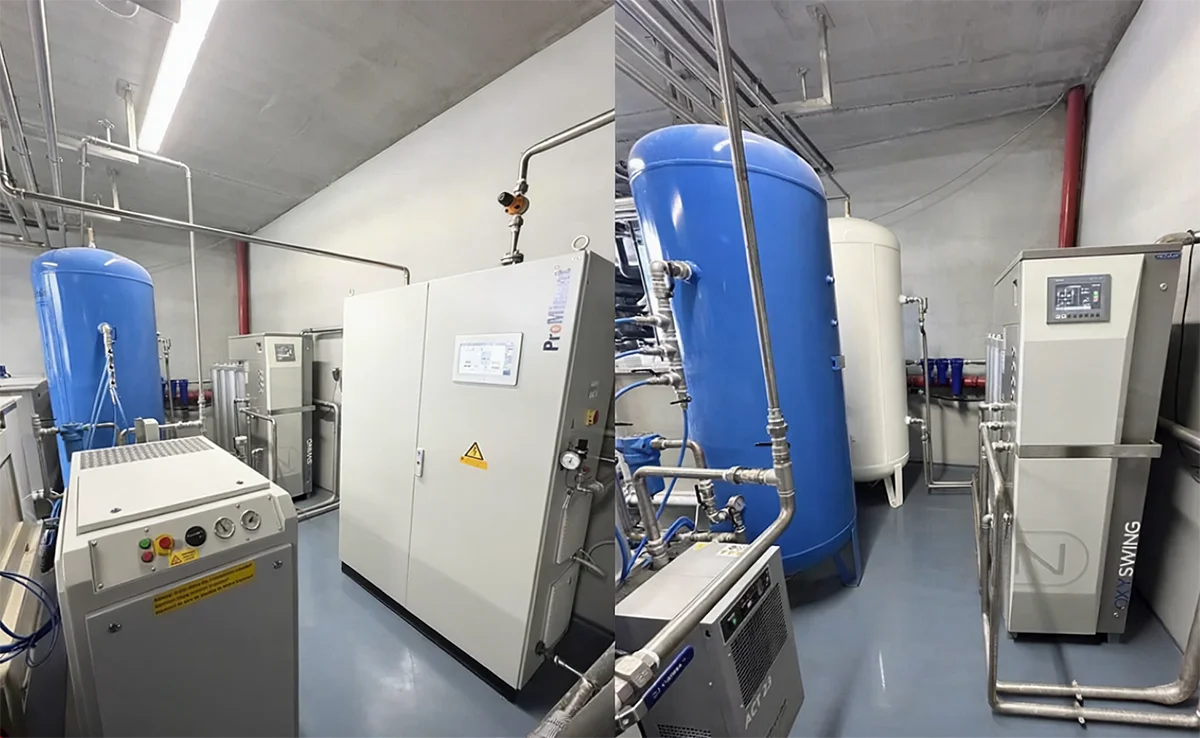
Ozone generator fed by a Novair O2 generator
Ozone, a powerful oxidant that leaves no chemical residue
Ozone is one of the most powerful oxidants used in water treatment. In particular, it can:
- oxidise part of the organic matter and certain micropollutants;
- improve the colour, odour and clarity of the water;
- contribute to disinfection and microbiological control.
It breaks down naturally into oxygen and therefore leaves no persistent chemical residue. This is an environmental advantage over some conventional chemicals.
Ozone in aquaculture
In aquaculture, ozone is used to treat both make-up water and recirculating loops. It complements mechanical and biological filtration. Combined with an oxygen generator, it offers an integrated approach to water quality: a single oxygen production unit supplies both tank oxygenation and ozonation.
Wastewater treatment: oxygen at the heart of tomorrow’s treatment plants
From wastewater treatment plant to resource recovery facility
Wastewater treatment plants (WWTPs) no longer simply treat wastewater before discharge. They are becoming resource recovery sites: biogas from sludge digestion, solar power on their large surfaces, heat recovery, nutrients and reusable water. They are now referred to as urban biorefineries.
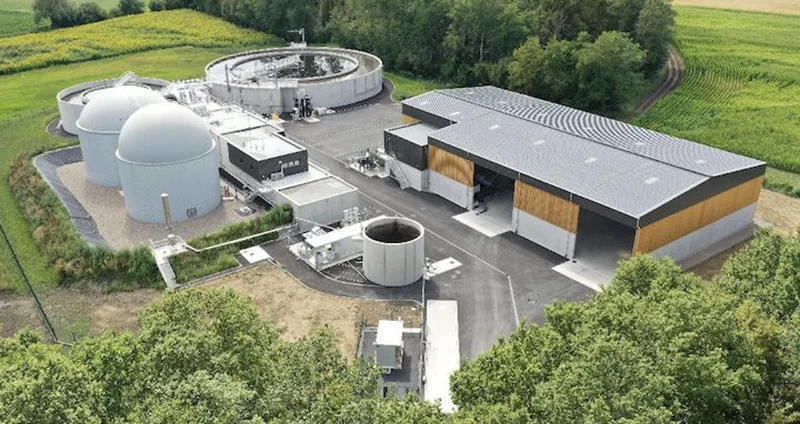
Benfeld wastewater treatment plant, including anaerobic digestion of process sludge
The roles of oxygen in a WWTP
Oxygen is involved at several levels:
- Biological treatment: it stimulates the activity of the micro-organisms that break down organic pollution.
- H₂S control: micro-aeration of digesters limits the formation of hydrogen sulphide in the biogas.
- Advanced treatment: it feeds ozone generators for micropollutant removal or disinfection.
Powered by electricity from the site’s biogas or solar panels, the oxygen generator becomes part of a virtuous local production loop.
Treated wastewater reuse: the role of ozone
With droughts and growing pressure on water resources, the reuse of treated wastewater is expanding, particularly for agricultural irrigation. To reach the quality required for the end use, additional treatment is often needed. Ozonation, supplied with oxygen produced on site, is an effective solution, selected according to the intended use and the health risk assessment.
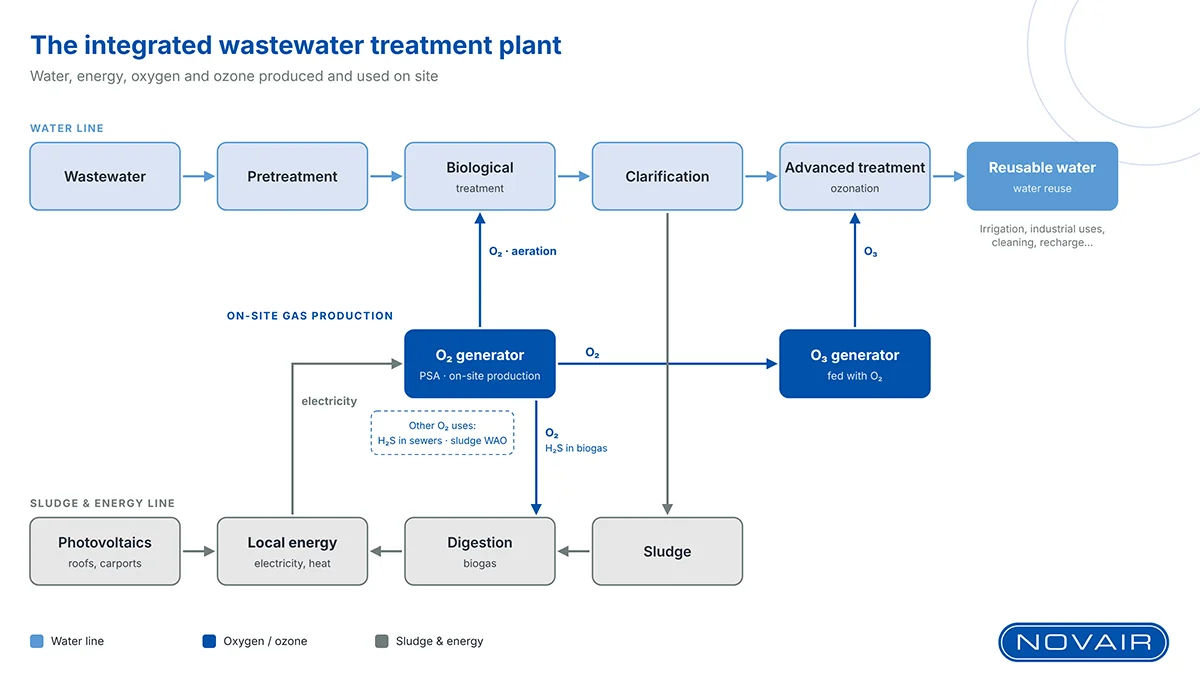
Towards integrated energy – oxygen – ozone – water systems
The challenge is not just to replace oxygen deliveries with a generator. It is about designing installations where energy, oxygen, ozone and water are produced, recovered and consumed locally, in a loop:
Local energy → O₂ → O₃ → Water treatment → Reuse
In this approach, the on-site oxygen generator is no longer a mere auxiliary unit. It is a core technology building block for the leaner, more self-sufficient and more resilient installations that the green transition calls for.
FAQ: oxygen generators and the green transition
Is an oxygen generator more environmentally friendly than liquid oxygen delivery?
In many cases, yes. It eliminates truck transport, cryogenic storage and boil-off losses. It can also run on renewable electricity produced on site. The exact balance depends on the volume consumed and on the electricity mix used for on-site generation versus cryogenic production plus transport.
What oxygen purity does a PSA generator produce?
A PSA generator typically produces oxygen with a purity of 90 to 95%, suitable for aquaculture, water treatment and feeding ozone generators.
Can an oxygen generator be powered by solar panels?
Yes, partly or fully depending on the sizing. A back-up solution or grid connection is usually still needed to guarantee continuous production, especially in aquaculture.
Conclusion: producing oxygen differently, as close as possible to where it is needed
Producing your own oxygen on site reflects a fundamental shift in industry: producing locally, making the most of available resources and reducing dependencies. In aquaculture as in water treatment, the oxygen generator links renewable energy, oxygenation, ozone production and water reuse.
The goal is therefore not only to produce oxygen differently, but to rethink the way we produce and use our resources.
Would you like to assess the benefits of an oxygen generator for your fish farm or treatment plant? Contact our Novair experts.