Why onsite oxygen production is reshaping aquaculture
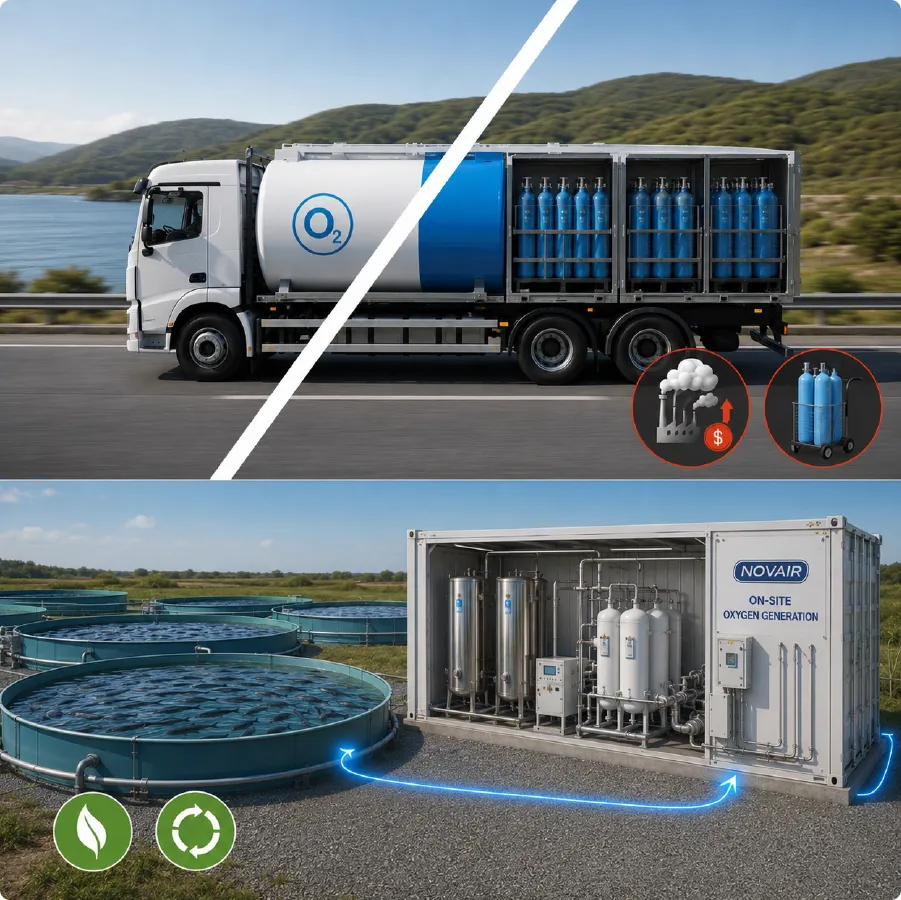
Why oxygen enables density (not aeration)
In intensive aquaculture, oxygen supply is often discussed through a narrow technical lens: comparing aeration systems, liquid oxygen (LOX), compressed oxygen cylinders, and onsite oxygen generators. While these technologies differ in cost, complexity, and logistics, the real transformation is not in the delivery method itself, but in what oxygen enables at system level.
Oxygen is no longer simply a support gas used to prevent hypoxia. It has become a core production parameter that defines how much biomass can be sustainably produced in a given volume of water.
As aquaculture intensifies, particularly in Recirculating Aquaculture Systems (RAS), oxygen increasingly becomes the first limiting factor before filtration capacity, feeding efficiency, or hydraulic design.
The structural limits of aeration systems
Traditional aeration remains effective for extensive and semi-intensive systems, but it is fundamentally constrained by physics:
- Oxygen transfer efficiency in water remains limited because air contains only ~21% oxygen.
- Gas–liquid exchange limits reduce efficiency as dissolved oxygen approaches saturation.
- Energy inefficiency at high stocking densities makes aeration increasingly costly as biomass increases.
At a certain point, adding more air no longer translates into proportional oxygen availability.
Pure oxygen changes the production ceiling
Pure oxygen systems, including LOX, cylinders, and onsite oxygen generators, remove these atmospheric constraints and allow:
- Much higher dissolved oxygen stability
- Increased biomass density per cubic meter
- Smaller rearing volumes for the same production output
In aquaculture economics, the key parameters are not only feed or oxygen consumption itself, but also infrastructure: tank volume, piping, water treatment, and land use.
From this perspective, oxygen is not just an input. It is a production enabler that defines system design and profitability.
LOX, cylinders and onsite oxygen generation
Once pure oxygen becomes necessary, the question shifts from “do we need oxygen?” to “how do we supply it?”
Three main approaches exist, each corresponding to a different operational philosophy.
Liquid oxygen (LOX)
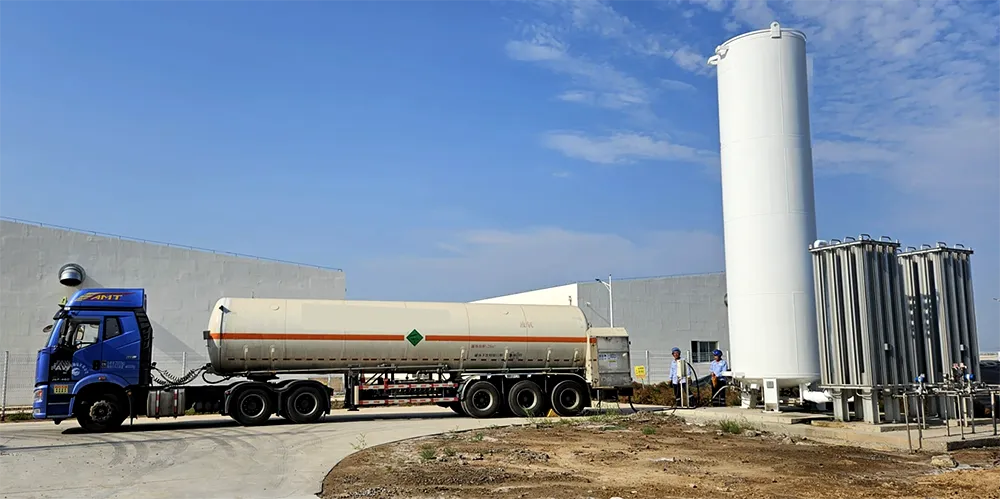
Liquid oxygen delivery on an aquaculture farm
LOX is the most widely used solution in industrial aquaculture.
Advantages:
- High purity oxygen
- Large volumes available
- Simple on-site vaporization systems
Limitations:
- Requires regular truck deliveries and logistics coordination
- Typically delivered in ~20-ton batches (system scale constraint)
- Storage constraints (safety zones, regulations, site footprint)
- Boil-off losses over time even when not used
- Exposure to supply chain disruptions
LOX is efficient, but dependent on external infrastructure.
Compressed oxygen cylinders
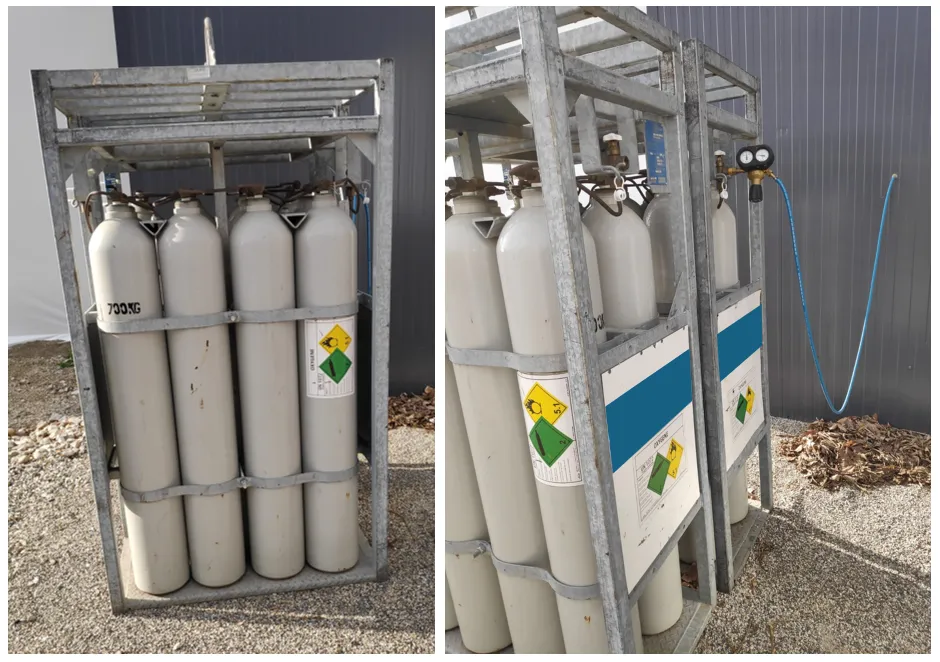
Compressed oxygen bottle on a small fishfarm
Cylinders are mainly used in small systems or as backup.
Advantages:
- Simple and widely available
- Very stable long-term storage
- Reliable emergency backup solution
Limitations:
- Very high cost per kg of O₂
- Frequent handling and logistics requirements
- Not scalable for industrial production volumes
Cylinders are practical but economically limited at scale.
Onsite oxygen generation
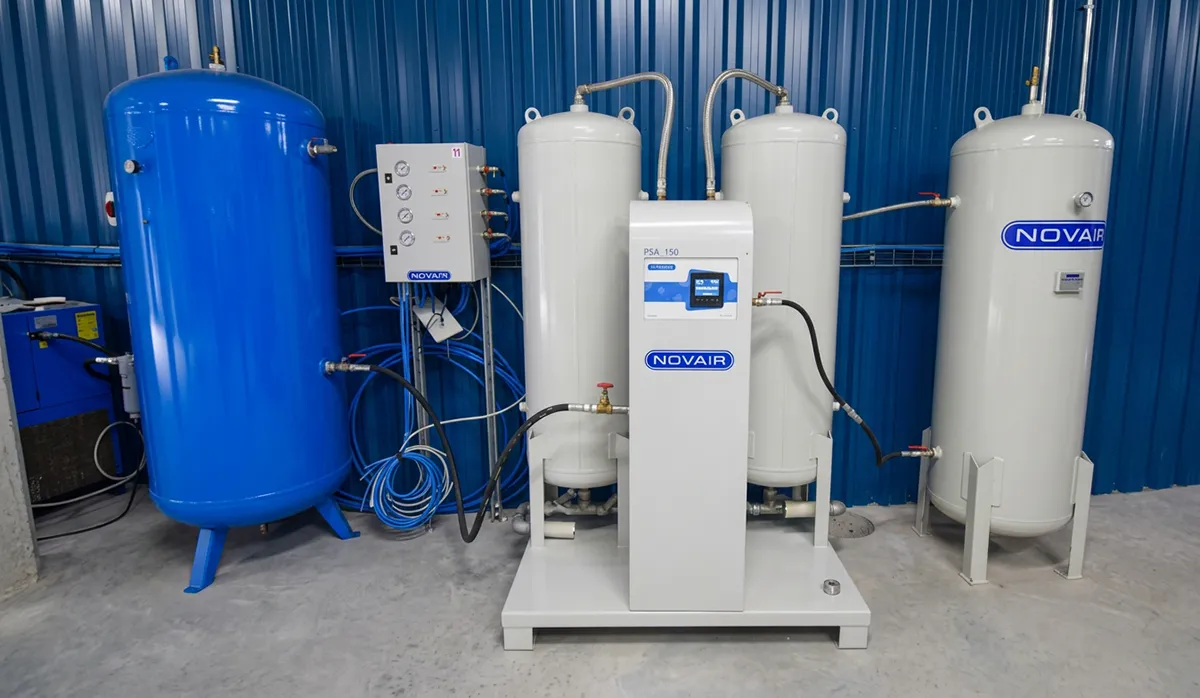
A medium size oxygen generator
Onsite oxygen generation transforms the traditional oxygen supply model by producing oxygen directly from ambient air using PSA (Pressure Swing Adsorption) or VPSA (Vacuum Pressure Swing Adsorption) technology.
Advantages:
- Stable operating costs: Oxygen production costs are primarily based on electricity consumption, making them largely independent of oxygen market price fluctuations and transportation costs.
- Continuous production: Designed to meet the stable, long-term oxygen demand typical of intensive aquaculture operations.
- Reduced supply chain risk: Eliminates dependence on road access, delivery schedules, and the availability of industrial gas suppliers.
Onsite oxygen generation is particularly well suited for:
- Remote fish farms and hatcheries (for example, island-based facilities);
- Regions with limited transport or gas distribution infrastructure;
- Large RAS (Recirculating Aquaculture System) facilities seeking greater operational autonomy.
With onsite generation, oxygen is no longer a delivered commodity but a utility produced directly at the farm.
Limitations:
• Higher initial capital investment.
• Dependence on electrical power.
• Periodic maintenance required.
• Typically sized to meet the average oxygen demand rather than short-term peak consumption.
Onsite oxygen generation is particularly attractive for facilities with a continuous and significant oxygen demand. However, it often delivers the greatest value when integrated into a hybrid oxygen supply strategy, combining an oxygen generator with a liquid oxygen (LOX) tank or compressed oxygen cylinders used exclusively for backup purposes or to cover peak oxygen demand.
Hybrid Systems, Large Farms and Oxygen Supply Autonomy
In practice, the most reliable oxygen supply strategies rarely rely on a single source. Aquaculture facilities, especially intensive farms and RAS (Recirculating Aquaculture Systems), are increasingly adopting hybrid configurations combining on-site oxygen production with stored oxygen as a backup solution.
The Hybrid Configuration: On-Site Production Combined with Backup Supply
A hybrid configuration generally combines:
- An on-site oxygen generator covering the base daily oxygen demand.
- Liquid oxygen (LOX) storage or compressed oxygen cylinders used to handle peak oxygen demand and ensure continuity in case of an incident.
This approach provides several advantages:
- Lower operating costs: the oxygen generator covers the majority of daily oxygen requirements and reduces dependence on external deliveries.
- Improved reliability: a backup oxygen source remains available in case of equipment failure, maintenance operations, or temporary increases in oxygen demand.
- Reduced logistical dependency: the farm becomes less vulnerable to delivery delays and external supply constraints.
The sizing of the backup solution mainly depends on the farm size and the criticality of the oxygen supply.
Small Farms and Hatcheries: Prioritizing Simplicity and Autonomy
For small farms and hatcheries, using liquid oxygen can quickly become disproportionate compared with actual oxygen demand:
- The investment and management of a cryogenic storage tank can be significant.
- LOX deliveries can be difficult to organize for low-volume consumption.
- The cost of oxygen cylinders is high when calculated per kilogram of oxygen consumed.
In these situations, a small PSA oxygen generator combined with a few backup cylinders is often a more suitable solution:
- Controlled investment.
- Predictable operating costs.
- Greater independence from oxygen suppliers.
- Simplified operation and maintenance.
For smaller facilities, the key consideration is therefore not only the oxygen cost, but the ability to guarantee a continuous supply with a simple and reliable solution.
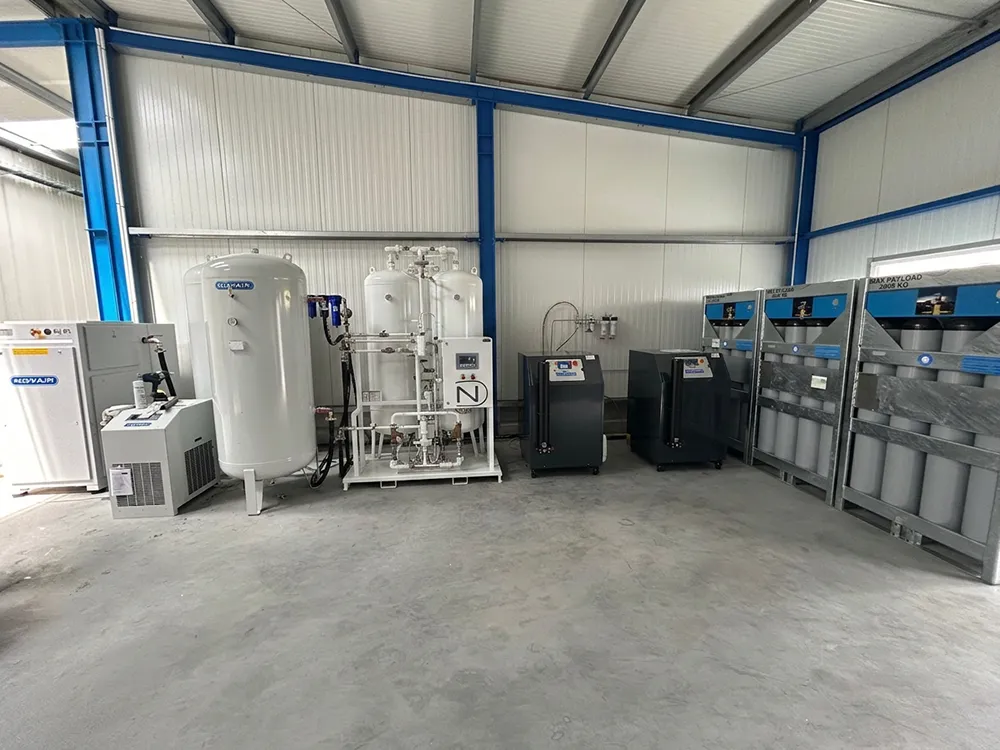
An oxygen generator combine to O2 compressed bottles
Large Aquaculture Farms: The Limits of LOX Supply Dependency
For very large aquaculture facilities, especially industrial-scale RAS farms, oxygen consumption can reach several tonnes per day. In these cases, liquid oxygen remains an important solution, but its logistical dependency becomes a critical factor that must be considered.
A LOX delivery truck typically has a limited transport capacity, usually in the range of several tens of tonnes. For a farm consuming, for example, 20 tonnes of oxygen per day, a single delivery only represents a few days of autonomy.
This creates several operational risks:
- Delayed or cancelled deliveries due to logistical issues.
- Dependence on the distance between the liquid oxygen production plant and the farm.
- The need to maintain large storage volumes to secure operations.
For these installations, a more robust strategy often combines:
- An on-site oxygen generator capable of covering a significant share of daily oxygen consumption.
- A LOX storage tank sized to handle peak demand and emergency situations.
- A backup strategy providing several days of autonomy in case of supply disruption.
Beyond a certain level of oxygen consumption, producing part of the oxygen directly on site is therefore no longer only an economic decision: it becomes an industrial risk management strategy.
Energy integration, heat recovery, and regulatory constraints
Energy integration improves competitiveness
Onsite oxygen generation becomes significantly more attractive when electricity is:
- Partially self-produced (solar, biogas, hybrid systems)
- Low-cost or time-optimized
This improves:
• OPEX competitiveness
• Carbon footprint reduction
• ESG performance
Heat recovery opportunities
Air compression used in PSA systems generates usable heat that can be recovered for:
- Water heating in RAS systems
- Building temperature control
- Greenhouse integration (for aquaponics farms)
- Process heat recovery
This improves overall site energy efficiency beyond oxygen production alone.
Regulatory and logistical constraints on LOX
LOX storage is increasingly affected by:
- Industrial safety regulations (e.g. SEVESO framework in Europe)
- Urban proximity restrictions (especially for aquaponic farms)
- Transport limitations
- Site access and footprint constraints
In some cases, these constraints can make onsite oxygen generation not just attractive, but necessary.
Oxygen as a strategic infrastructure decision
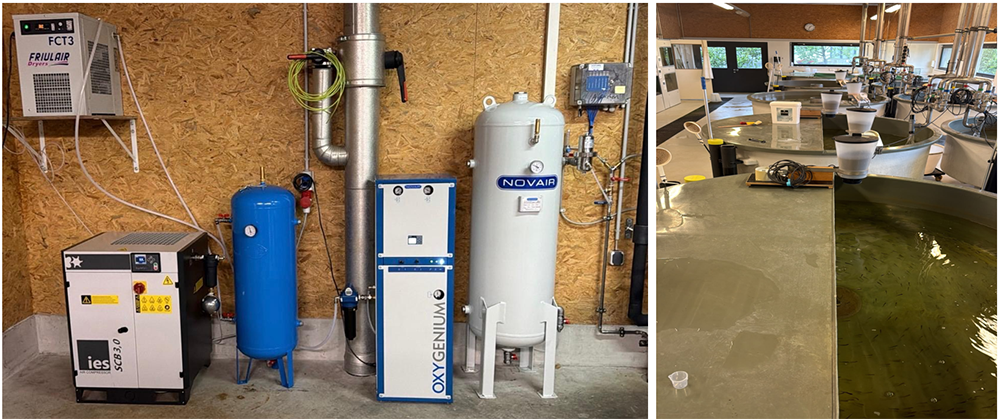
A small oxygen generator on a fish hatchery
The choice between LOX, cylinders, and onsite oxygen generation is no longer purely technical. It is strategic.
The real transition in aquaculture can be summarized simply:
- LOX → centralized supply model dependent on logistics
- O2 Cylinders → small-scale or backup solution
- Onsite generators → decentralized oxygen production and autonomy
- Hybrid systems → industrial best practice for resilience
Ultimately, the industry is shifting from oxygen delivery systems to oxygen production systems, where oxygen is no longer a purchased consumable, but a locally managed infrastructure resource that directly defines production capacity.