In cell culture, oxygen is not merely a supplementary gas—it is a process parameter. As cell density increases, air alone is no longer sufficient to maintain the target dissolved oxygen level. The challenge is not to provide more oxygen, but to provide just the right amount, in a reproducible manner, from the first trial through the entire development campaign.
In biopharmaceutical process development laboratories, the management of dissolved oxygen (DO) determines growth, viability, and, often, product quality. Here’s how oxygen control works in a bioreactor, in which applications high-purity oxygen provides true flexibility, and what criteria matter when choosing a source.
Why is air no longer sufficient?
Mammalian cells consume oxygen continuously. As viable cell density and oxygen consumption rate (OCR) increase, the gas-to-liquid transfer achieved with air alone may become insufficient to maintain the process’s DO setpoint.
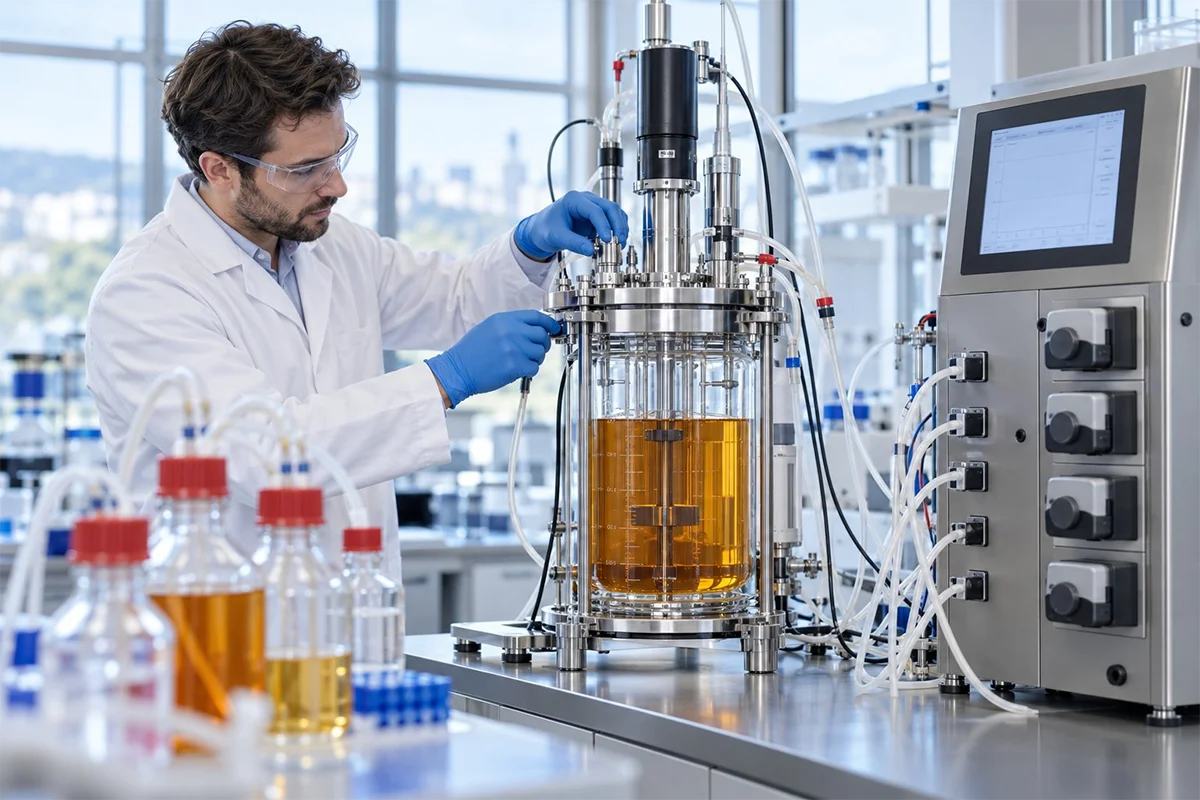
Modern bioreactors address this with a cascade control system: the controller first adjusts agitation and air flow rate, then adds oxygen only when necessary.
- Base: air or head gas, sufficient at low cell density.
- Primary control: agitation and air flow increase oxygen transfer.
- O₂ enrichment: air + supplemental oxygen when the maximum air flow rate is reached.
- Feedback: the DO probe and the controller continuously adjust the gas supply to the setpoint.
In this context, oxygen is not just another parameter to adjust: it is the final margin of control that allows the process to be maintained without compromise.
Control oxygen, don’t maximize it
Published CHO processes for monoclonal antibodies operate with DO setpoints of 20%, 40%, or 50% of air saturation, maintained by oxygen sparging or air–oxygen mixtures. The goal is controlled oxygen availability, never the highest possible concentration.
An oxygen source therefore does not “over-oxygenate” the culture. It supplies the bioreactor’s gas system with the gas required by the control strategy, and it is the controller that decides when and how much to add to maintain the validated setpoint.
This point also applies to intensified cultures. Simply increasing the air flow rate involves trade-offs: bubble-induced shear, foaming, the need for defoamers, and CO₂ stripping. Enriching the inlet gas with oxygen allows for additional mass transfer without increasing the gas volume proportionally.
Where high-purity oxygen is a game-changer in R&D
Monoclonal antibodies and CHO process development
CHO cells are one of the main expression platforms for therapeutic antibodies. In fed-batch culture, the growing biomass causes oxygen demand to rise sharply. Once the air flow rate ceiling is reached, additional oxygen allows the controller to maintain DO without relying solely on a higher total flow rate. Recent scale-up studies, such as that by Lemire et al. (Biotechnology Progress, 2026), describe in detail a cascade system that delivers pure oxygen on demand once this limit is reached.
- Screening of clones and media in controlled bioreactors
- Optimization of fed-batch processes
- Evaluation of DO setpoints and aeration cascades
- Scale-down models of manufacturing processes
- Studies linking aeration strategy, growth, viability, titer, and product quality
Recombinant proteins
The same principles apply to other aerobic expression systems: enzymes, fusion proteins, antibody fragments, and other biological products. A dedicated oxygen source supports reproducible experiments as cell density and oxygen consumption change throughout the run, particularly in fed-batch or long-term perfusion cultures.
High-Density and Intensified Cultures
Intensified fed-batch and perfusion cultures achieve high viable cell densities, resulting in high oxygen demand. For an R&D team, the value lies in flexibility: comparing air inlets, enrichment strategies, agitation, and sparger configurations, with a reproducible oxygen source from one run to the next.

Scale-up, scale-down, and aeration strategies
Oxygen transfer is a key parameter in scale-up. The teams use bench-top reactors and mini-bioreactors to replicate the oxygen transfer and gas management constraints of larger tanks. Controlled O₂ supply allows for the systematic study of kLa, oxygen consumption, agitation, gas flow rate, and CO₂ removal.
- 1–10 L bench-top development reactors
- High-throughput mini-bioreactor systems
- Scale-down models of manufacturing processes
- Pilot process development skids
- Comparison of sparging and agitation strategies
The oxygen source: now a strategic choice
For runs lasting several days or even several weeks, a continuous oxygen supply is essential for experimental reliability. Cylinders require inventory, cylinder changes, and delivery logistics. On-site production shifts the focus: oxygen is generated from ambient air, right where the process is being developed.
For an R&D laboratory, this approach offers several advantages:
- Continuous availability during long-term cultures
- Less dependence on cylinder inventory, cylinder changes, and deliveries
- Stable source for repeated experimental design campaigns, clone screening, and process development
- Compact and quiet integration near bioreactor platforms
- Scalable architecture as the number of research bioreactors increases
This type of application includes, for example, the ionic ceramic technology originally developed with NASA and deployed in laboratory generators such as NOVAIR’s ION®: up to 99.9999% purity, 3 L/min, and 6.89 bar (100 psi) in the standard configuration, produced from ambient air in a compact and quiet design, with scalable capacity. This type of generator is installed upstream of the mass flow meters and the bioreactor’s gas mixing manifold—that is, upstream of the validated gas management system.
The specifications above correspond to a reference configuration. Actual compatibility must always be verified for each bioreactor platform.
Qualification and Sizing: Two Key Considerations
Purity alone is not enough. It does not establish a gas’s suitability for a regulated bioprocess. Before use, the laboratory must verify the bioreactor manufacturer’s requirements: purity and acceptable impurities, filtration and sterility strategy, pressure, flow rate, materials, connections, and, where applicable, GMP qualification.
Sizing is the critical step. Oxygen consumption depends heavily on reactor volume, viable cell density, ORP, kLa, the sparger, agitation, the DO setpoint, and the cascade strategy. Published studies show very low requirements in mini-bioreactors and significantly higher requirements as the scale increases. To confirm a sizing, the following information must be provided at a minimum:
- the bioreactor model and its working volume
- the number of reactors
- the maximum range of the O₂ mass flow meter
- the required inlet pressure
- the expected operating cycle
- the gas quality specification
Beyond R&D, a large production bioreactor may require a flow rate higher than that of a single unit: the requirement then depends on the application.
Oxygen: a process enabler rather than a consumable
Biopharma R&D teams need to control oxygen, not manage cylinders. Producing high-purity oxygen directly from ambient air, upstream of a qualified gas system, supports laboratories developing monoclonal antibodies, recombinant proteins, and intensified culture processes where supplemental oxygen is part of the DO control strategy.
The real question is no longer “how much oxygen to deliver” but “how to have a continuous, reproducible, and process-specific on-site source.” For many laboratories, the transition from an oxygen delivery system to an oxygen production system is the logical next step in this line of thinking.